LEARN / ARTICLE
Consistency You Can Rely On: PT Forvis Mazars Indonesia Is a Clean Air Zone
Since August 2023, PT Forvis Mazars Indonesia has treated healthy indoor air as part of everyday workplace operations, illustrated by an August 2025 snapshot of 6 µg/m³ indoor PM2.5 against 40 µg/m³ outdoors in Jakarta.
Jakarta’s Outdoor Air Reality
Jakarta’s outdoor air can be unforgiving, especially when fine particulate pollution (PM2.5) climbs and stays elevated across a month. That matters because offices are not sealed worlds: outdoor air moves in through ventilation systems, building infiltration, and daily foot traffic.
To ground this in a specific moment, June 2025 was a clearly difficult month, with 47 µg/m³ outdoor PM2.5. In conditions like that, protecting healthy indoor air becomes a practical leadership decision, creating a stable environment for people to work, even when the city outside is not stable.
Why Healthy Air Matters for Offices
Offices run on cognition. A normal day is full of tasks that rely on attention, memory, and mental control: reading and reviewing, building presentations, resolving issues, making decisions, and staying focused through meetings and deadlines.
One peer-reviewed intervention study looked at short-term exposure to indoor PM2.5 in an office setting and how it relates to adult cognitive performance. The researchers used a randomized single-blind cross-over design in an urban office, placing portable air purifiers on workstations: in the intervention condition purifiers were switched on to control PM2.5 in the breathing zone, and in the control condition purifiers were present but switched off. In that study, the average PM2.5 level was 18.0 μg/m³ in control versus 3.7 μg/m³ in intervention, and cognitive testing began 5–7 hours after arriving at the office.
The results reported that office workers had significantly better performance in 9 out of 16 cognitive skills during the intervention compared to control, with the most consistent effect in the memory domain.
This is not a promise about any one workplace or person, and it’s not a substitute for the many other factors that shape performance. But it supports a grounded point for office leaders: PM2.5 is not just an environmental number. In a work context, it’s part of the everyday conditions under which people think, process information, and execute. That’s why “healthy air” works best as a managed standard, visible, repeatable, and sustained over time.
www.forvismazars.com
PT Forvis Mazars Indonesia Is a Clean Air Zone, A Representative Month Snapshot
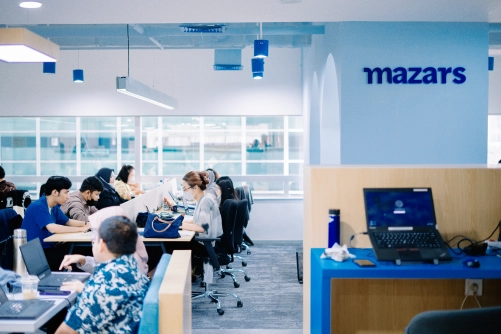
PT Forvis Mazars Indonesia has been a Clean Air Zone since August 2023. This milestone is less about a one-time announcement and more about an operational choice: treating healthy indoor air as something you maintain calmly and consistently.
To share a representative snapshot, here is August 2025:
- Average indoor PM2.5 (August 2025): 6 µg/m³
- Average outdoor PM2.5 (August 2025): 40 µg/m³
In a city where outdoor PM2.5 can remain high, that indoor–outdoor separation is a useful month-level indicator that indoor air is being actively managed, while staying appropriately humble about what a single month can and cannot prove.
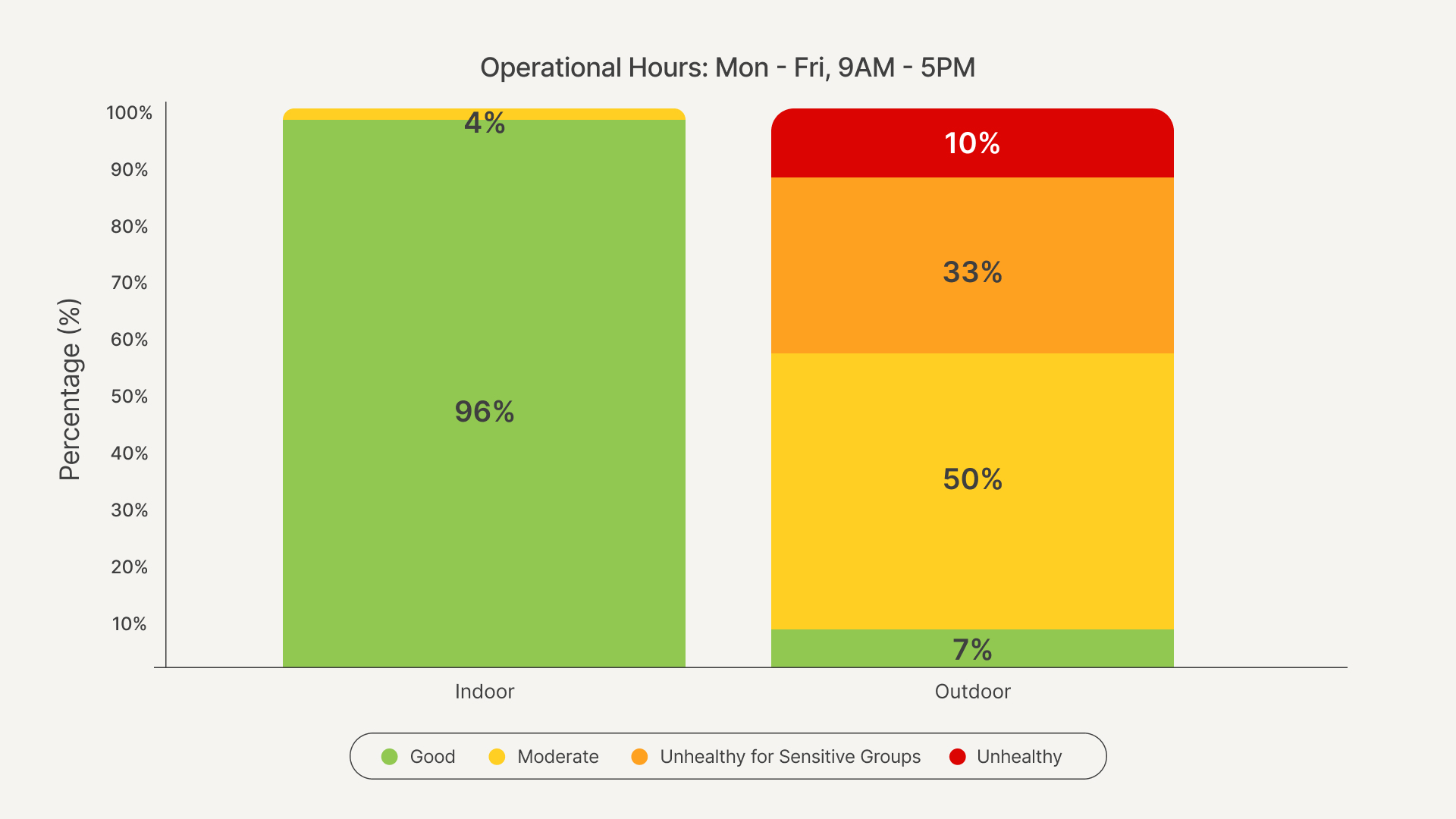
Each month, PT Forvis Mazars Indonesia receives a Clean Air Zone email report summarizing indoor PM2.5 alongside outdoor PM2.5 for the same period. It’s designed as a simple transparency and accountability tool: a shared reference point for leadership and site teams, built for ongoing visibility rather than one-time validation.
“What we value most about working with Nafas is the consistency of the Clean Air Zone over time. Since August 2023, the system has helped us maintain stable indoor air conditions as part of our everyday workplace operations.”
— Alyssa, PT Forvis Mazars Indonesia
What stands out in this reflection is the word consistency. Healthy air isn’t something most teams want to “manage manually” week to week. When it becomes part of daily operations, measured, reviewed, and sustained, teams gain a steadier baseline without adding complexity to the workday.
What a Clean Air Zone Represents
A Clean Air Zone is not a badge, it’s a managed condition. It means PM2.5 is treated as a workplace baseline that can be monitored, reviewed, and sustained with calm rigor.
For PT Forvis Mazars Indonesia, this is a milestone worth celebrating precisely because it is practical: measurable performance, a repeatable monthly reporting rhythm, and a long-term commitment to keeping the workplace environment stable. As healthy air becomes a modern expectation at work, leadership often shows up in quiet systems, standards that hold up month after month, especially when the city outside doesn’t cooperate.